Current uses of RFID:
In 2010 three key factors drove a significant increase in RFID usage: decreased cost of equipment and tags, increased performance to a reliability of 99.9% and a stable international standard around UHF passive RFID. The adoption of these standards were driven by EPCglobal, a joint venture between GS1 and GS1 US, which were responsible for driving global adoption of the barcode in the 1970s and 1980s. The EPCglobal Network was developed by the Auto-ID Center, an academic research project headquartered at the Massachusetts Institute of Technology (MIT) with labs at five leading research universities around the globe: Cambridge, Adelaide, Keio, Shanghai, Fudan, St. Gallen. At RFID Journal Live 2010 in Orlando, Airbus detailed 16 active projects, IBM and—most recently added to the team—CSC. The two other areas of significant use are financial services for IT asset tracking and healthcare. RFID is becoming increasingly prevalent as the price of the technology decreases.
Electronic vehicle registration
With security of cars being a major concern in many countries, some
countries are using RFID technology for vehicle registration and
enforcement. RFID can help detect and retrieve stolen cars.
Payment by mobile phones
Since summer 2009, two credit card companies have been working with Dallas, Texas-based Device Fidelity to develop specialized microSD cards. When inserted into a mobile phone, the micro SD card can be both a passive tag and an RFID reader. After inserting the micro SD, a user's phone can be linked to bank accounts and used in mobile payment.
Transportation payments
Governments use RFID applications for traffic management, while automotive companies use various RFID tracking solutions for product management. Many of these solutions may work together in the future, though privacy regulations prevent many initiatives from moving forward at the same pace that technology allows.
Car-sharing:
The Zipcar car-sharing service uses RFID cards for locking and unlocking cars and for member identification.
Season parking tickets:
Following a successful pilot, Housing & Development Board (HDB)
Singapore called two tenders in 2006 to implement RFID to replace the
paper Season Parking Ticket (SPT). The successful tenders have
distributed RFID tags to SPT holders since March 2007.
Toll roads:
- In Mexico, RFID technology is being used extensively and is implemented by Neology
- In Pakistan, RFID is being used for e–tolling in Motorways, implemented by NADRA.
- In India, various toll booths are now in the process of implementing RFID.
- In Dubai, UAE, RFID is being used for e–tolling – RFID Cards (named SALIK) are used on Motorways, implemented by RTA.
- In Turkey, 13.56 MHz RFID cards have been used in the motorways and bridges as a payment system since 2005; it is also used in public transportation systems in Istanbul, Çanakkale, Izmir and Denizli.
- RFID is used in Malaysia's Touch 'n Go. As the system's name indicates, the card is designed to only function as an RFID card when the user touches it.
- In Norway, all public toll roads are equipped with an RFID payment system known as AutoPASS.
- In Italy, all public toll roads are equipped with an optional RFID payment system named Telepass.
- In Greece, public toll roads in the Attica and Peloponnese regions are equipped with an RFID payment system known as E-Pass.
- In Ireland, the eToll system uses RFID tags for payments on all road tolls, including the barrier-free M50 toll between exits 6 and 7.
Public transit (bus, rail, subway):
Europe:
- Throughout Europe, and in particular in Paris (system started in 1995 by the RATP), Lyon, Bordeaux, Grenoble, Nancy and Marseilles in France, in the whole of the Portuguese highway system and in many Portuguese public car parks, Milan, Turin, Naples and Florence in Italy, and Brussels in Belgium, RFID passes conforming to the Calypso international standard are used for public transport systems.
- The Moscow Metro, the world's second busiest, was the first system in Europe to introduce RFID smart cards in 1998.
- In the UK, operating systems for prepaying for unlimited public transport have been devised, making use of RFID technology.
Asia:
- In South Korea, T-money cards can be used to pay for public transit. It can also be used in most convenience stores and vending machines in subways as cash. 90% of cabs in Seoul accept card payment, including most major credit cards and the T-money card. T-money replaced Upass, first introduced for transport payments in 1996 using MIFARE technology.
- In Hong Kong, mass transit is paid for almost exclusively through the use of an RFID technology, called the Octopus Card.
- In Shanghai the Shanghai Public Transportation Card allows the user to credit money in advance and to be debited according to the distance travelled, as determined by the check-in and check-out stations. The card can also be used to pay taxi drivers, and some shops offer card readers as well.
- In Dubai, (United Arab Emirates) drivers through Sheikh Zayed Road and Garhoud Bridge pay tolls using RFID tags called Salik (road toll). Dubai has also initiated a public transportation card named Nol[27] (which means fare in Arabic) for use in the metro, bus, and waterbus. It was introduced to service on 9 September 2009, the day of the official launch of the Dubai Metro.
North America:
The Washington Metro rail became the first U.S. urban mass-transit system to use RFID technology when it introduced the SmarTrip card in 1999.The Chicago Transit Authority has offered the Chicago Card and the Chicago Card Plus for rail payments across the entire system since 2002 and for bus payments since 2005.
The MBTA introduced the RFID enabled CharlieCard across Boston's subway, streetcar, and bus system in 2006, replacing the decades-old token based fare collection system.
In Canada, Metrobus in St. John's adopted RFID on December 1, 2006. In the Greater Toronto and Hamilton areas, under Metrolinx, full implementation of the RFID farecard Presto began in November 2009, and will be rolled out in stages across the network.
South America:
- In Porto Alegre, the card used in buses is called "cartão TRI" (TRansporte Integrado), it comes in many varieties, including one for workers (which is recharged by the company you work for), one for students (who pay half the cost for each travel), one for old people and people with disabilities (who can travel for free) etc.
- In Rio de Janeiro, "RioCard" passes can be used in buses, ferries, trains and subway. There are two types: one you cannot recharge, the other one can be recharged if it's been bought by the company you work for, if they provided it (only in Brazil).
- In Santiago the subway system Metro and the recently implemented public transportation system Transantiago use an RFID card called "Bip" or "Multivia".
- In Medellín, the recently-implemented card system for the Metro system uses an RFID card called Cívica.
- In Cali, the recently-implemented card system for the Masivo Integrado de Occidente(MIO) system uses an RFID card.
- In Buenos Aires, Monedero is an RFID card used in all metro lines and, since May 2009, on some bus lines as an experimental program. The card can also be used to pay, as a debit card in some small shops and in toll roads. The Monedero card could be prepaid or linked to a credit card.
- Australia:
- The Transperth public transport network in Perth, Western Australia uses RFID technology its SmartRider ticketing system, allowing passengers to "tag on" and "tag off" and be charged automatically, according to how many zones they have travelled.
Bicycle locker:
Some bike lockers
are operated with RFID cards assigned to individual users. A prepaid
card is required to open or enter a facility or locker and is used to
track and charge based on how long the bike is parked.
Asset management and retail sales:
RFID combined with mobile computing
and Web technologies provide a way for organizations to identify and
manage their assets. It was initially introduced to major retail by
Craig Patterson, Knoxville, TN.
Mobile computers, with integrated RFID readers, can now deliver a
complete set of tools that eliminate paperwork, give proof of
identification and attendance. This approach eliminates manual data
entry.
RFID is being adopted for item-level retail uses. Aside from efficiency and product availability gains, the system offers a superior form of electronic article surveillance (EAS), and a superior self checkout process for consumers. The first commercial, public item-level RFID retail system installation is believed to be in May 2005 by Freedom Shopping, Inc. in North Carolina, USA.
Product tracking:
RFID use in product tracking applications begins with plant-based production processes, and then extends into post-sales configuration management policies for large buyers.
Casino chip tracking:
In 2005, the Wynn Casino,
Las Vegas, began placing individual RFID tags on high value chips.
These tags allowed casinos the ability to detect counterfeit chips,
track betting habits of individual players, speed up chip tallies, and
determine counting mistakes of dealers. In 2010, the Bellagio casino
was robbed of $1.5 million in chips. The RFID tags of these chips were
immediately invalidated, thus making the cash value of these chips $0.
IT asset tracking:
By 2011 there are more than 100 passive RFID tags that are meant to
be specifically mounted on metal. Members of the financial service
industry, including Wells Fargo, Bank of America, Morgan Stanley,
Citigroup, Fidelity and others, are purported to have tagged more than
one million assets.
Garment tracking:
RFID can also be used for supply chain management in the fashion
industry. The RFID label is attached at the garment at production, can
be read/traced througout the entire supply chain and is removed at the
point of sale (POS).
Transportation and logistics:
- Logistics and transportation are major areas of implementation for RFID technology. For example, yard management, shipping and freight and distribution centers are some areas where RFID tracking technology is used. Transportation companies around the world value RFID technology due to its impact on the business value and efficiency.
- Qantas has introduced RFID cards and bag tags in their "Next Generation Check-in" system into the airlines' Australian domestic airport terminals from late 2010 to speed passenger check-in and tracking and recovery of their luggage.
- Baggage passing through the Hong Kong International Airport are individually tagged with "HKIA" RFID tags as they navigate the airport's baggage handling system, which improves efficiency and reduces misplaced items.
Cattle Tracking/ Animal identification:


RFID tags for animals represent one of the oldest uses of RFID
technology. Originally meant for large ranches and rough terrain, since
the outbreak of mad-cow disease, RFID has become crucial in animal identification management.
An implantable variety of RFID tags or transponders can also be used for animal identification. The transponders are more well-known as passive RFID technology, or simply "chips" on animals.
RFID tracking and tracing for meat packers:
The Canadian Cattle Identification Agency
began using RFID tags as a replacement for barcode tags. The tags are
required to identify a bovine's herd of origin and this is used for
tracing when a packing plant condemns a carcass. Currently CCIA tags are
used in Wisconsin and by US farmers on a voluntary basis. The USDA is currently developing its own program.
Inventory systems:
An advanced automatic identification technology such as the Auto-ID Labs
system based on the Radio Frequency Identification (RFID) technology
has significant value for inventory systems. Notably, the technology
provides an accurate knowledge of the current inventory. In an academic
study
performed at Wal-Mart, RFID reduced Out-of-Stocks by 30 percent for
products selling between 0.1 and 15 units a day. Other benefits of using
RFID include the reduction of labor costs, the simplification of
business processes, and the reduction of inventory inaccuracies.
Hospital and Healthcare:
Adoption of RFID in the medical industry has been widespread and very
effective. Hospitals are among the first users to combine both active
and passive RFID technology. Many successful deployments in the
healthcare industry have been cited where active technology tracks
high-value, or frequently moved items, where passive technology tracks
smaller, lower cost items that only need room-level identification.
- Mayo Clinic was awarded the most innovative use of RFID in 2009 for their tracking of specimens in the pathology lab. Error rates were reduced from 9% to under .05%.
RFID mandates:
Wal-Mart and the United States Department of Defense have published requirements that their vendors place RFID tags on all shipments to improve supply chain management.
Due to the size of these two organizations, their RFID mandates impact
thousands of companies worldwide. The deadlines have been extended
several times because many vendors face significant difficulties
implementing RFID systems. In practice, the successful read rates
currently run only 80%, due to radio wave attenuation caused by the products and packaging. In time it is expected that even small companies will be able to place RFID tags on their outbound shipments.
Wal-Mart mandate:
 an EPC RFID tag used byWal-Mart.
In January 2005, Wal-Mart required its top 100 suppliers to apply
RFID labels to all shipments. To meet this requirement, vendors use RFID
printer/encoders to label cases and pallets that require EPC tags for Wal-Mart. These smart labels are produced by embedding RFID inlays inside the label material, and then printing bar code and other visible information on the surface of the label.
In October 2005 the University of Arkansas' Information Technology
Research Institute released a report on its preliminary study of the
impact of RFID on reducing retail out-of-stocks and concluded that RFID
reduced OOS by 21% over non-RFID based stores.
Two years later the Wall Street Journal published an article titled
"Wal-Mart's Radio-Tracked Inventory Hits Static." The articles stated
that the RFID plan set forth by Wal-Mart was "showing signs of fizzling"
due to a lack of progress by Wal-Mart executives to introduce the
technology to its stores and to the non-existent incentives for
suppliers.
In October 2007 Wal-Mart announced new focus areas for its RFID implementation:
- Shipments going to Sam's Club
- Promotional displays and products going to Wal-Mart stores
- Tests to see RFID's impact in improving category management in select areas
Department of Defense mandate:
The DoD requirements for RFID tags on packages is prescribed in the
Defense Federal Acquisition Regulations Supplements (DFARS)
252.211-7006. Positioning of the tag needs to be completed in accordance with the clause and definitions in MIL STD 129 and as of 1 March 2007, EPC Global tags must comply with EPCglobal Class 1 Generation 2 specification.
Promotion tracking:
Manufacturers of products sold through retailers promote their
products by offering discounts for a limited period on products sold to
retailers with the expectation that the retailers will pass on the
savings to their customers. However, retailers typically engage in forward buying,
purchasing more product during the discount period than they intend to
sell during the promotion period. Some retailers engage in a form of arbitrage, reselling discounted product to other retailers, a practice known as diverting.
To combat this practice, manufacturers are exploring the use of RFID
tags on promoted merchandise so that they can track exactly which
product has sold through the supply chain at fully discounted prices.
Libraries:

Among the many uses of RFID technology is its deployment in libraries. This technology has slowly begun to replace the traditional barcodes on library items (books, CDs, DVDs,
etc.). The RFID tag can contain identifying information, such as a
book's title or material type, without having to be pointed to a
separate database (but this is rare in North America). The information is read by an RFID reader, which replaces the standard barcode reader
commonly found at a library's circulation desk. The RFID tag found on
library materials typically measures 50×50 mm in North America and
50×75 mm in Europe. It may replace or be added to the barcode, offering a different means of inventory management by the staff and self service by the borrowers. It can also act as a security device, taking the place of the more traditional electromagnetic security strip.
Passports:
The first RFID passports ("E-passport") were issued by Malaysia
in 1998. In addition to information also contained on the visual data
page of the passport, Malaysian e-passports record the travel history
(time, date, and place) of entries and exits from the country.
Schools and universities:
School authorities in the Japanese city of Osaka are now chipping children's clothing, back packs, and student IDs in a primary school.
Museums:
RFID technologies are now also implemented in end-user applications
in museums. An example was the custom-designed temporary research
application, "eXspot," at the Exploratorium, a science museum in San Francisco, California.
Social retailing:
When customers enter a dressing room, the mirror reflects their image
and also images of the apparel item being worn by celebrities on an
interactive display. A webcam also projects an image of the consumer
wearing the item on the website for everyone to see. This creates an
interaction between the consumers inside the store and their social
network outside the store. The technology in this system is an RFID
interrogator antenna in the dressing room and Electronic Product Code RFID tags on the apparel item.
Race timing:
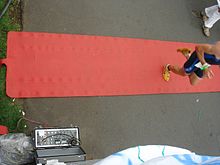
J-Chip 8-channel receiver next to timing mat. The athlete wears a chip on a strap around his ankle. Ironman Germany 2007 in Frankfurt.

Many forms of RFID race timing have been in use for timing races of
different types since the early 1990s. The practice began with pigeon
racing, introduced by a company called deister electronic Gmbh
of Barsinghausen, Germany. It is used for registering race start and
end timings for animals or individuals in large running races or
multi-sport races where it is impossible to get accurate stopwatch
readings for every entrant.
In the race, the racers wear passive or active tags that are read by
antennae placed alongside the track or on mats across the track. UHF
based tags instead of low or high frequency last-generation tags provide
accurate readings with specially designed antennas. Rush error, lap
count errors and accidents at start time are avoided since anyone can
start and finish any time without being in a batch mode.
Lap scoring:
Passive and active RFID systems are used in off-road events such as Orienteering, Enduro and Hare and Hounds
racing. Riders have a transponder on their person, normally on their
arm. When they complete a lap they swipe or touch the receiver which is
connected to a computer and log their lap time.
Ski resorts:
A number of ski resorts, particularly in Scandinavia, the French Alps and in the Spanish and French Pyrenees, have adopted RFID tags to provide skiers hands-free access to ski lifts.
Skiers do not have to take their passes out of their pockets. Early on
skiers were forced to use systems that required nearly contact - bending
over to touch the turnstyles.
Human implants:
Implantable RFID chips designed for animal tagging are now being used in humans. An early experiment with RFID implants was conducted by British professor of cybernetics Kevin Warwick, who implanted a chip in his arm in 1998. In 2004 Conrad Chase offered implanted chips in his night clubs in Barcelona and Rotterdam to identify their VIP customers, who in turn use it to pay for drinks.Potential uses:
RFID can be used in a variety of applications,[89][90] such as:
- Access management
- Tracking of goods and RFID in retail
- Tracking of persons and animals
- Toll collection and contactless payment
- Machine readable travel documents
- Smartdust (for massively distributed sensor networks)
- Tracking sports memorabilia to verify authenticity
- Airport baggage tracking logistic
Complement to barcode:
RFID tags are often a complement, but not a substitute, for UPC or EAN
barcodes. They may not ever completely replace barcodes, due in part to
their higher cost and the advantage of multiple data sources on the
same object. Also, unlike RFID labels, barcodes can be generated and
distributed electronically, e.g. via e-mail or mobile phone, for printing and/or display by the recipient. An example is airline boarding passes. The new EPC, along with several other schemes, is widely available at reasonable cost.
